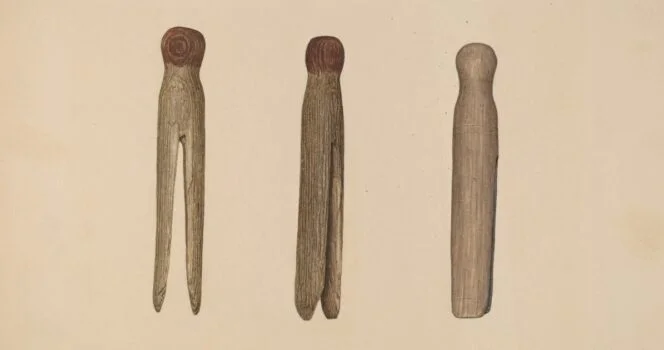
Long before dryers mysteriously swallowed socks, people relied on simple yet clever tools to handle household chores. One such tool was the wooden peg, which eventually evolved into the two-piece clothespin we know today. This design was a huge improvement over earlier versions that often let garments fly away in the wind—a problem washerwomen called a “serious evil.”
Recently, someone shared a photo of small wooden dowels with two legs on social media, puzzled about their purpose. The answer came swiftly: “Old school clothespins, used to hang wet laundry on a clothesline to dry in the sun and fresh air!”
The clothespin’s history stretches back centuries, with early versions handcrafted from wood, bone, or even stone. The modern spring-loaded style was patented in 1853 by Vermont inventor David M. Smith. His design allowed a stronger grip, preventing clothes from blowing away.
Despite industrial advances and the rise of plastic alternatives, wooden clothespins remain beloved worldwide. They’re practical, eco-friendly, and carry a touch of nostalgia.
So, what’s worse—losing socks in the wind or the dryer?
