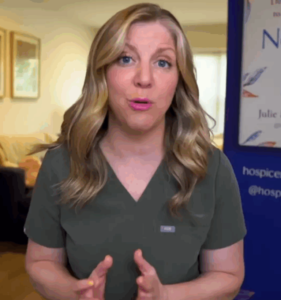
A hospice nurse has lifted the lid on the signs she sees most often in the final 24 hours of a patient’s life, and says they’re not as terrifying as people might think.
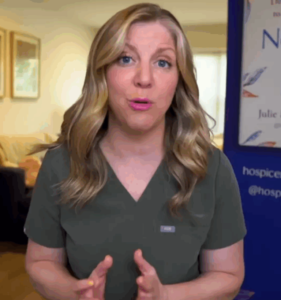
Julie McFadden, a California-based palliative care nurse known online as Nurse Julie, has worked in end-of-life care for 16 years. She’s gained 1.7 million TikTok followers by sharing her experiences and helping to break the stigma and fear around death.
Julie has even written a book, Nothing to Fear: Demystifying Death to Live More Fully, explaining what really happens in our last moments.
Speaking on the Dr Karan Explores podcast, she said some people appear to have a surprising level of control over when they pass. “They basically will say, ‘I’m going to die after this date’ or ‘I’ll wait for my daughter’s wedding,’” she said.
“I’ve literally had a patient say, ‘I’m dying tonight’ and then die, even though they weren’t actively dying at the time.”
Now, Julie has shared the three most common signs she’s seen when death is just a day away.
1. The ‘death rattle’
The first — and often most unsettling for families — is a sound called the “death rattle.” This happens when the patient can no longer swallow or cough, allowing saliva and mucus to collect in the throat and airways.
As air moves through the fluid, it creates a rattling or gurgling noise. According to Julie, this almost always happens within 24 hours of death but despite how it sounds, it’s not painful. “It’s just part of the body shutting down,” she explains.
2. Changes in breathing
The second sign is a change in breathing patterns. Breaths may become slower, more irregular, or spaced far apart. Some patients take long pauses between breaths, making it look like they’ve stopped breathing entirely.
In the final hours, many people also display “agonal breathing”; short, gasping breaths that can appear alarming. Julie reassures families that this is a natural reflex when the brain isn’t getting enough oxygen, and it’s not causing the patient distress.
3. The ‘death stare’
Finally, Julie describes what she calls the “death stare.” The patient may have their eyes and mouth open but be completely unresponsive. Their gaze is fixed and unfocused, as if “no one’s really home.”
While it can be confronting, Julie says it’s often a peaceful moment, and that hearing is usually the last sense to go, meaning loved ones’ voices can still be comforting.
She stresses these signs are common, but not universal. “Some people die suddenly, some take longer,” she says. “But knowing what to expect can make it less scary for everyone.”
