If you see this in your backyard, you had better know what it means

Owning a backyard and caring for plants may be a gratifying experience. However, it is not without its obstacles. You may come across unusual things that make you wonder what’s going on. A Reddit member in Oklahoma recently discovered a strange sight in their trees: a large amount of yellow jelly and what they described as a “jelly alien nut”. Intrigued and perplexed, they sought solutions from the internet community.

This puzzling condition was discovered to be a rust disease known as cedar-apple rust. It needs two hosts to complete its life cycle, with apples and crabapples being the most frequently afflicted. While the name suggests cedars, it can also appear on juniper trees. Identifying Cedar-Apple Rust. Cedar-apple rust symptoms vary according to the type of tree affected. On juniper trees, brown, perpetual galls grow on the twigs.
When the weather becomes rainy in April, these galls grow orange gelatinous horns. While the twig beyond the gall may perish, there is no considerable harm to the juniper host. Circular yellow lesions emerge on apple or crabapple trees’ leaves immediately after blooming. As the summer passes, these lesions turn into brownish clusters of threads or cylindrical tubes. They can be found under the spots on leaves, twigs, and fruits.
You might be wondering how long this disease lasts. Galls occur about seven months after the original infection. After 18 months, they become gelatinous blobs. In the spring, golf-ball-shaped depressions emerge on the galls, giving rise to telial horn. When it rains in the spring, the brownish telial horns extend and turn a vibrant orange. After they release their spores, the horns collapse, dry out, and eventually fall off.
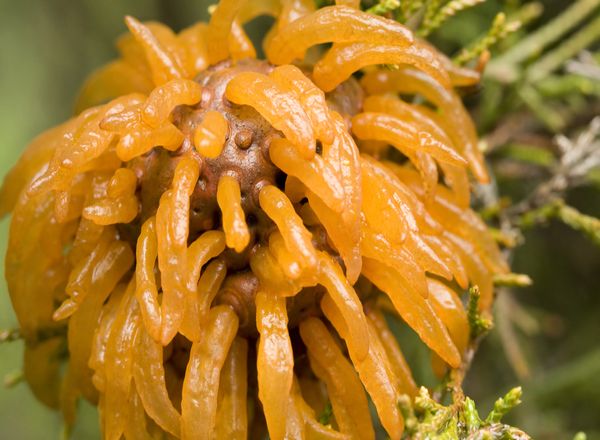
While the galls die, they stay attached to the tree for at least a year. The illness is most visible in spring, when the galls are covered in gelatinous masses. Fortunately, treating this infection is rather simple. To prevent the infection from spreading further, you can prune the affected regions. However, it is important to note that cedar-apple rust does not destroy your trees; it simply causes cosmetic damage to the plants.
If you prefer a preventative strategy, you can use fungicides or select apple types that are resistant to this disease. Conclusion. To summarize, cedar-apple rust may be a strange look in your backyard, but it does not represent a substantial threat to your trees. It is critical to be aware of this virus so that you know how to respond if it appears. Share this information with others so that they can spot and understand cedar-apple rust. Happy gardening!
