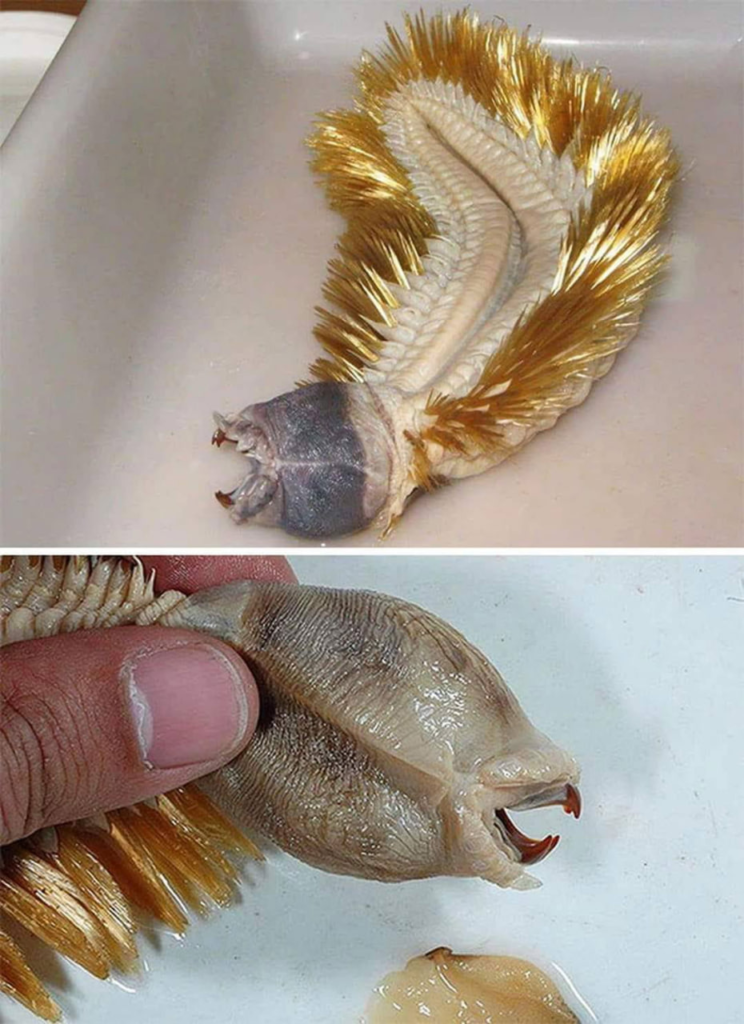
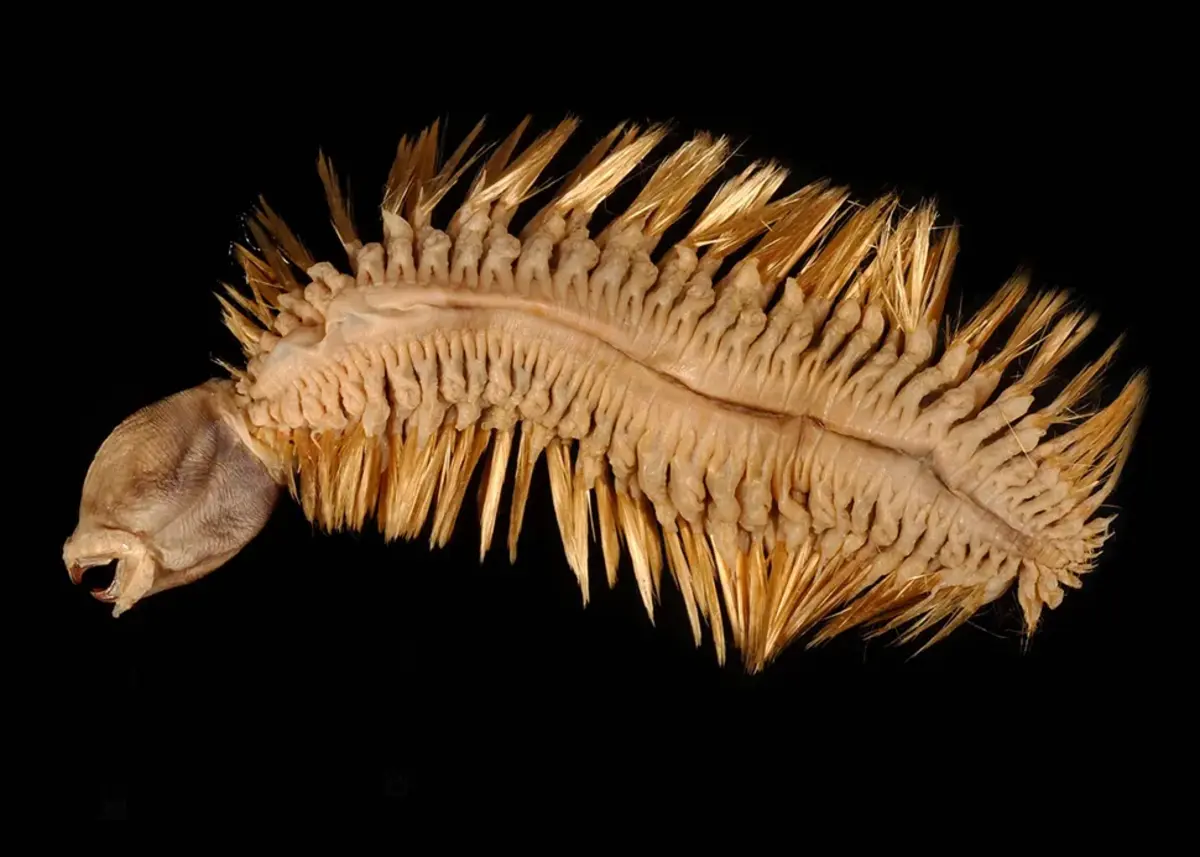
A bizarre marine worm found in the icy waters near Antarctica is grabbing attention online—and it’s not hard to see why. With an oval-shaped body covered in shimmering golden bristles and a gaping, tooth-lined maw, this creature looks like a holiday ornament straight out of a horror movie.
Known as Eulagisca gigantea, the worm is part of the polychaete family, often called bristle worms due to their signature spiky exteriors. While it may have recently gone viral thanks to striking photos shared on social media, this unusual worm is a long-time resident of the Southern Ocean near Antarctica.
A Look at the Strange Predator
Measuring about 8 inches in length, Eulagisca gigantea has a distinctive “head” that is actually a retractable pharynx. When feeding, this section of its throat extends outward, revealing sharp teeth that hint at its predatory habits. The Smithsonian Museum of Natural History notes that this throat extension can reach up to 2 inches, allowing the worm to scavenge or prey on other marine creatures.
Its bristles, which glow a metallic gold, may serve multiple purposes—swimming, defense, or crawling along the seafloor. However, much about this deep-sea species remains a mystery, as scientists have not extensively studied its biology or behavior since it was first identified in 1939, according to the World Register of Marine Species.
Photo Credit: Ben G Thomas/YoutubeDeep-Sea DiversityPolychaete worms, the group to which this creature belongs, are incredibly diverse. Found in environments ranging from shallow coral reefs to extreme hydrothermal vents, these worms come in a variety of shapes, sizes, and colors. The Monterey Bay Aquarium Research Institute (MBARI) reports that there are 80 known families and over 8,000 species of polychaete worms, though researchers believe the actual number may be much higher.A 2016 study published in Royal Society Open Science used DNA analysis to estimate that the number of undiscovered marine worm species could be double current estimates. These creatures, while strange to human eyes, play vital roles in ocean ecosystems and offer insights into the mysteries of life in the deep sea.Photo Credit: Ben G Thomas/YoutubeViral SpecimenA recent Facebook post highlighting Eulagisca gigantea showcased a specimen retrieved from a depth of 1,706 to 2,198 feet in the Antarctic Ocean. The image captured its extruded jaws and the eye-catching golden hue of its bristles, sparking fascination and a mix of horror among viewers.Photo Credit: Ben G Thomas/YoutubeWhile its alien-like appearance may seem unsettling, creatures like Eulagisca gigantea are crucial for understanding deep-sea biodiversity. As researchers continue to explore the ocean’s depths, such discoveries remind us of the strange and remarkable life forms thriving far beneath the waves.
Social media users are criticizing the Trump administration not only over escalating military action against Iran but also over the operation’s reported name, “Operation Epic Fury,” which…
Modern LED headlights are designed to illuminate the road more effectively. However, their whiter, more concentrated beams can easily overwhelm tired eyes, especially during rain or when…
The Supreme Court has allowed a federal policy to take effect requiring U.S. passports to list sex designations consistent with biological sex assigned at birth. The decision…
Medical professionals are urging patients to maintain calm vigilance regarding their health. The advice comes with a simple but crucial message: awareness saves lives.Patients should regularly review…
Donald Trump’s recent statements about Iran reveal a troubling blend of personal security and international policy. He has warned that any assassination attempt against him would trigger…
During remarks in 2025, Donald Trump attempted to balance menace with a fleeting promise of peace. He spoke of wanting nations to peacefully coexist, yet immediately vowed…