The Egg-Citing Riddle That’ll Twist Your Brain (And Taste Buds!)
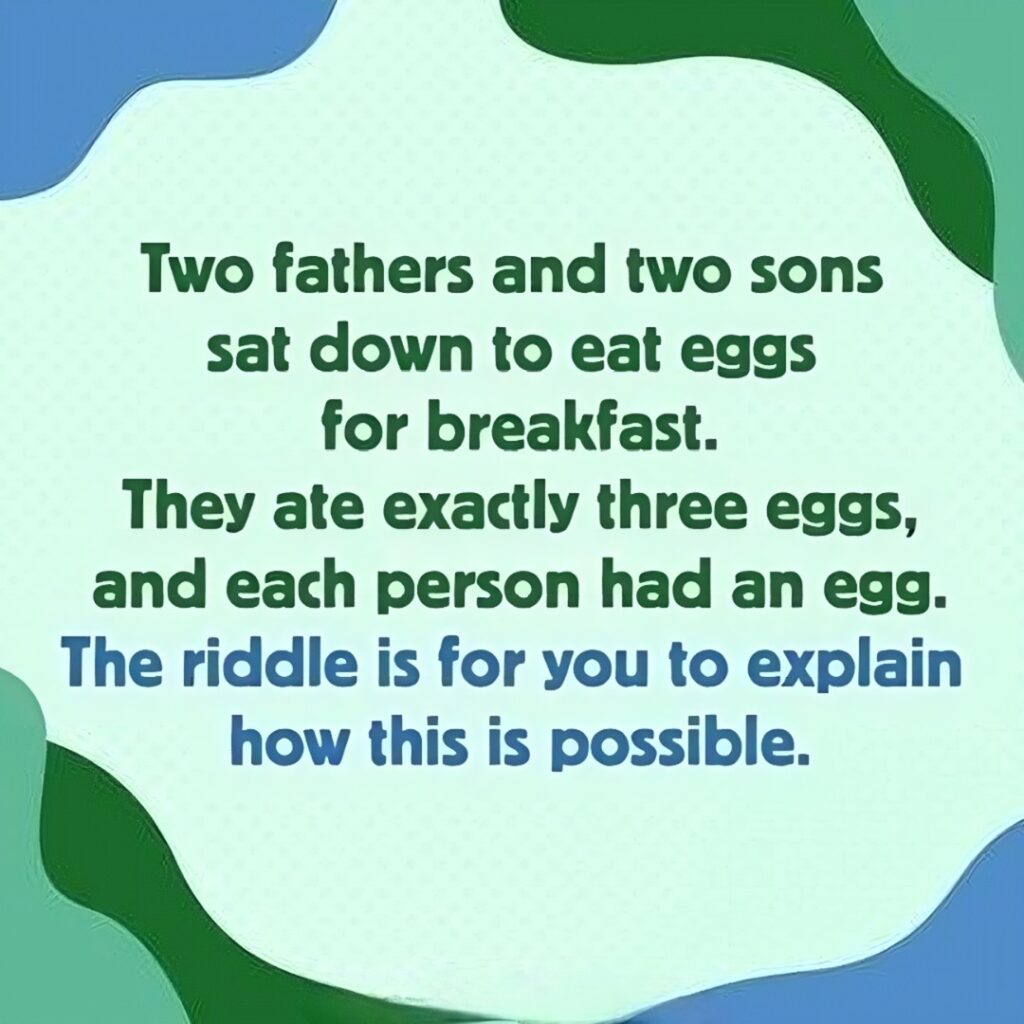
At first glance, the scenario of two fathers and two sons sitting down for a breakfast of three eggs seems perplexing. How can each person have an egg if there are only three eggs total? This seemingly impossible riddle challenges our assumptions and requires us to think beyond the literal interpretation to uncover the hidden family dynamics at play.
The key to solving this riddle lies in the careful wording used to describe the relationships between the individuals. When the riddle refers to “two fathers and two sons,” it is not necessarily implying that there are four distinct people. Instead, the “two fathers and two sons” can be understood as a grandfather, a father, and their two sons – a grandfather, a father, and two grandsons.

In this interpretation, the “two fathers” are the grandfather and the father, while the “two sons” are the father and his two children. This subtle distinction resolves the apparent contradiction, as each person in the group would have consumed one egg, despite the familial titles used.
also read
The use of “two fathers and two sons” in the riddle is a clever linguistic device that requires the reader to think beyond the literal interpretation and consider alternative family dynamics. This type of puzzle not only challenges our assumptions but also encourages critical thinking and a deeper understanding of language and relationships.
