I Brought Lunch to My Husband’s University Lecture – I Was Horrified to See My Face on His Presentation Slide
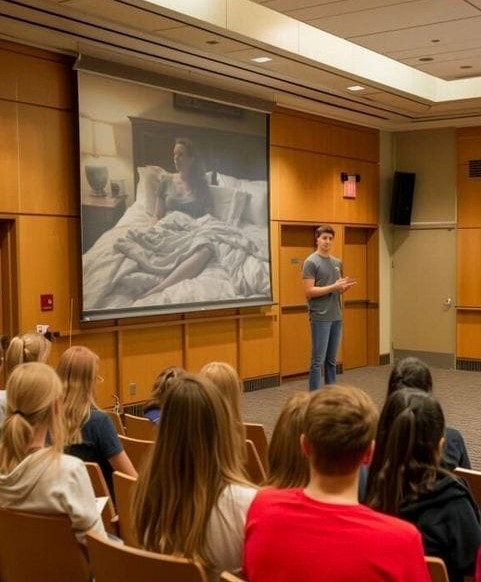

My intention was simple and sweet: deliver the lunch my husband, Mark, a psychology professor, had forgotten in his morning rush. I could never have imagined that my spontaneous visit to his university would unveil a shocking betrayal that threatened to unravel our decade-long marriage.
“Mark, you left your lunch again,” I sighed that morning, holding the brown paper bag aloft as he scrambled for his keys.
ALSO READ
“Sorry, honey,” he mumbled, barely glancing back as he dashed out the door.
Given that I had the day off, I thought a quick trip to his campus might be a nice surprise, not just to bring him his lunch but to catch a glimpse of him in his element. The university was bustling with life—students milling about, the fall sun illuminating the ivy-draped buildings with a warm glow. It felt like a scene from a college brochure, filled with promise and youthful energy.
Arriving at the lecture hall, I hesitated at the door, peering in to see if Mark had started his presentation. The hall was steep, rows of seats filled with students descending to the stage where Mark stood, commanding and articulate. I slipped into the back row, my heart swelling with pride at the sight of him so animated and passionate about his work.

As I settled in, Mark was deep into his lecture on cognitive psychology, discussing the malleability of human memory. His lecture was captivating, filled with interesting anecdotes and studies. Then, without warning, the focus shifted dramatically.
“To illustrate the impact of suggestion on memory,” Mark announced, transitioning to a new slide, “I conducted an experiment with a very familiar subject—my wife, Janet.”
My heart stopped. An uncomfortable murmur rippled through the room as my face appeared on the large screen behind him. Below my image were bullet points that made my stomach churn: “Subject exhibits traits commonly associated with suggestibility, such as a low threshold for anxiety and a high degree of trustfulness.”
“Our subject, Janet, believes she possesses an average IQ and displays the social grace of a somewhat naïve adolescent. Let’s observe a video demonstrating the implantation of a false memory.”
A video started playing on the screen, showing me discussing a childhood incident—a vivid account of getting lost in a mall, an event that I slowly realized had never actually happened. Mark had been planting these seeds for weeks through our conversations, subtly weaving this narrative into our daily interactions. The betrayal was not just personal; it was academic, laid bare in front of a room full of students.
I sat frozen, mortification setting in as the clip ended and a series of text messages between Mark and me appeared, clearly showing his methodical planting of this fictional memory. The room was silent, save for the clicking of students typing notes. This wasn’t just a lecture; it was my personal life turned into a case study without my consent.
As Mark continued to explain the experiment, detailing how easily a person could be led to believe a fabricated event, the professional detachment in his voice felt like a slap. “This demonstrates the fragility of human memory and the power of suggestion,” he concluded, looking pleased with himself.
My shock turned to anger as I stood up, interrupting the Q&A session that had just begun. “What if your subject—your wife—discovered she was part of an experiment without her consent? How do you think she would react?”
The room turned to me, a collective intake of breath. Mark, recognizing my voice, went pale. “Janet, I can explain,” he stammered.
“I’d be curious to hear this explanation,” I said, my voice cold and loud. “Would she feel honored or humiliated? Respected or violated?”
Mark attempted to regain his composure. “I believe she would understand that her participation was crucial to demonstrating a significant psychological phenomenon. She would, I hope, appreciate the scientific value of our findings.”
