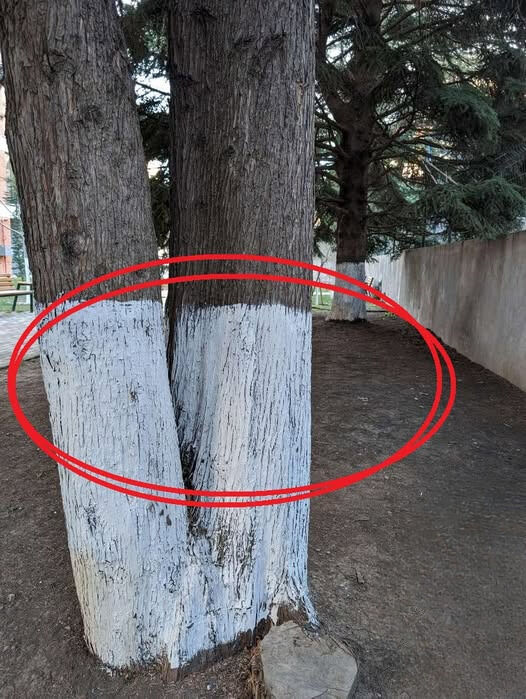
For years, I walked past trees with white-painted trunks without giving them a second thought. I assumed the coating was decorative or simply an old landscaping habit passed down through generations. It wasn’t until I spoke with a seasoned arborist that I learned the truth: that simple white ring is one of the most effective protections a young tree can receive during winter.
The paint isn’t symbolic. It isn’t a boundary mark like blue, orange, or purple markings often seen on public land. Instead, its purpose is scientific. During winter, sunlight can warm one side of a tree’s trunk far more than people realize. When temperatures drop rapidly at night, the bark contracts too quickly, causing vertical cracks known as sunscald. These splits allow insects, bacteria, and rot to enter—damage that may not become visible until months later.
White paint reflects sunlight, preventing the bark from overheating in the first place. That keeps the trunk’s temperature stable and dramatically reduces the risk of cracking. Farmers, orchard managers, and arborists have relied on this method for generations, especially for young or thin-barked trees.
What once looked decorative is, in fact, an old but effective act of protection—proof that even the simplest traditions often have science behind them.
