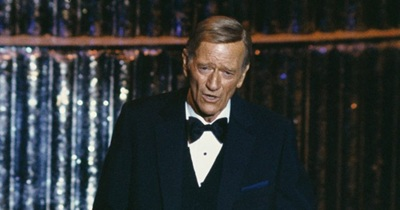
When the lights dimmed inside the Dorothy Chandler Pavilion on April 9, 1979, a hush fell over Hollywood — not the polite quiet that precedes an awards segment, but a deep, collective silence filled with nostalgia, reverence, and a hint of fear.
Every person in that grand room, from up-and-coming actors to the most seasoned legends, sensed that they were about to witness something unforgettable.
Because behind the curtain, gathering his strength and steadying his breath, stood John Wayne — the man who had
John Wayne had spent more than fifty years embodying American heroism on screen, surviving studio fights, political storms, and serious medical battles. But on the night of the 1979 Academy Awards, he faced his hardest challenge yet. The ceremony was memorable—Johnny Carson’s effortless humor, heartfelt speeches, and major wins for The Deer Hunter and Coming Home—but the true emotional center of the night was Wayne himself.
Just months earlier, what should have been a routine gallbladder surgery revealed advanced stomach cancer. Surgeons removed his entire stomach in a nine-hour operation. This came after surviving lung cancer in 1964 and open-heart surgery in 1978. At seventy-two, frail and recovering, Wayne wasn’t expected to return to public life. Yet when Bob Hope personally invited him to present at the Oscars, Wayne agreed.
When he appeared, thinner and slower but still unmistakably “The Duke,” the room rose to its feet. It wasn’t applause—it was a farewell. Wayne smiled, delivering a humble line: “That’s just about the only medicine a fellow would ever really need.” It became his final public appearance, a moment of courage, grace, and quiet strength.
